


Cranial Nerve Functions
This section gives an overview of what cranial nerves carry out what functions: motor, sensory, or mixed(both).
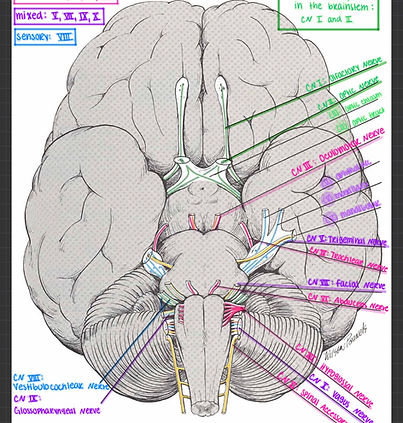


CRANIAL NERVE I: OLFACTORY
The olfactory nerve is a special sensory nerve that is responsible for the sense of smell.
CRANIAL NERVE II: OPTIC
The optic nerve is a special sensory nerve that is responsible for vision.
CRANIAL NERVE III: OCULOMOTOR
The oculomotor nerve originates in the midbrain.
This is a motor nerve that is both somatic motor and visceral motor.
The somatic motor modality provides motor innervation to 4 of 6 extraocular muscles, excluding the superior oblique (4) and lateral rectus (6) muscles; this allows for lateral eye movement outwards (abduction).
The visceral motor modality provides parasympathetic stimulus to ciliary and pupillary constrictor muscles, allowing for pupil constriction.
CRANIAL NERVE IV: TROCHLEAR
The trochlear nerve originates in the midbrain.
This is a somatic motor nerve that innervates the superior oblique extraocular muscle, allowing for vertical eye movement.
CRANIAL NERVE V: TRIGEMINAL
The trigeminal nerve has mixed functions, it is both motor and sensory.
The trigeminal nerve has nuclei in the midbrain, pons, and medulla.
It provides motor innervation to muscles of mastication.
It also receives sensory information from the surface of the head and neck, sinuses, meninges, and tympanic membrane.
CRANIAL NERVE VI: ABDUCENS
The abducens nerve originates in the pons and is a motor nerve.
This nerve provides innervation to the lateral rectus extraocular muscle, allowing for lateral eye movement inwards (adduction).
CRANIAL NERVE VII: FACIAL
The facial nerve originates in the pons and has a mixed modality; it is both sensory and motor.
It provides motor innervation to muscles of facial expression and parasympathetic innervation to all of the glands of the head (excluding the parotid and integumentary glands).
It receives sensory information from a region around the outside of the ear, the tympanic membrane, as well as taste signals from the anterior 2/3 of the tongue.
CRANIAL NERVE VIII: VESTIBULOCOCHLEAR
The vestibulocochlear nerve originates in the pons is a sensory nerve.
It is responsible for maintaining balance and is involved in hearing/audition.
CRANIAL NERVE IX: GLOSSOPHARYNGEAL
The glossopharyngeal nerve originates in the medulla and has a mixed modality; it is both sensory and motor.
It provides motor innervation to the stylopharyngeus muscle and provides parasympathetic innervation to the parotid gland; this allows for swallowing and salivation.
This nerve receives visceral sensory information from the carotid body.
It also receives and communicates sensory information from the posterior 1/3 of the tongue and the interior surface of the tympanic membrane, as well as taste from the posterior 1/3 of the tongue.
This nerve is involved in the gag reflex and taste.
CRANIAL NERVE X: VAGUS
The vagus nerve originates in the medulla and is a mixed nerve; having both motor and sensory modalities.
This nerve provides motor innervation to the pharynx and larynx; as well as providing parasympathetic motor stimulation to the pharynx, larynx, and both the thoracic and abdominal viscera (organs).
It receives and communicates sensory information from the pharynx, larynx, and viscera, as well as from a small area around the external ear.
The vagus nerve is responsible for motor to and sensation from the heart, blood vessels, viscera, as well as the pharynx and larynx.
CRANIAL NERVE XI: SPINAL ACCESSORY
The spinal accessory nerve is a motor nerve that provides motor innervation to the sternomastoid and trapezius muscles; this allows for movement of the neck and shoulder muscles.
CRANIAL NERVE XII: HYPOGLOSSAL
The hypoglossal nerve is a motor nerve, originating in the medulla, that innervates the intrinsic and extrinsic muscles of the tongue, excluding the palatoglossus; this allows for movement of tongue.
DIAGRAMS


